
Free PDF Inventing the Flat Earth: Columbus and Modern Historians, by Jeffrey Burton Russell
Inventing The Flat Earth: Columbus And Modern Historians, By Jeffrey Burton Russell. In undergoing this life, several individuals always aim to do as well as get the very best. New knowledge, encounter, session, and also everything that can boost the life will certainly be done. Nonetheless, lots of people occasionally really feel confused to obtain those points. Feeling the minimal of encounter and resources to be better is among the does not have to own. However, there is an extremely simple point that could be done. This is just what your educator always manoeuvres you to do this. Yeah, reading is the answer. Reviewing a publication as this Inventing The Flat Earth: Columbus And Modern Historians, By Jeffrey Burton Russell as well as other referrals can enhance your life top quality. Exactly how can it be?
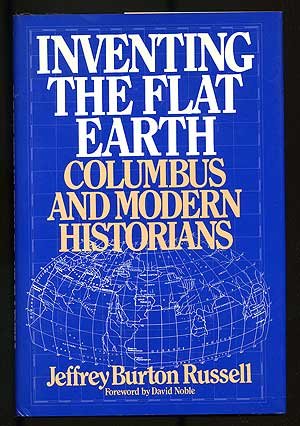
Inventing the Flat Earth: Columbus and Modern Historians, by Jeffrey Burton Russell

Free PDF Inventing the Flat Earth: Columbus and Modern Historians, by Jeffrey Burton Russell
Inventing The Flat Earth: Columbus And Modern Historians, By Jeffrey Burton Russell. Learning how to have reading routine is like learning to try for consuming something that you truly do not want. It will require more times to aid. Additionally, it will additionally bit pressure to serve the food to your mouth and also swallow it. Well, as reviewing a book Inventing The Flat Earth: Columbus And Modern Historians, By Jeffrey Burton Russell, often, if you should review something for your new works, you will feel so lightheaded of it. Also it is a publication like Inventing The Flat Earth: Columbus And Modern Historians, By Jeffrey Burton Russell; it will make you feel so bad.
It can be among your morning readings Inventing The Flat Earth: Columbus And Modern Historians, By Jeffrey Burton Russell This is a soft data publication that can be survived downloading from online publication. As known, in this innovative era, modern technology will reduce you in doing some activities. Also it is merely checking out the visibility of publication soft data of Inventing The Flat Earth: Columbus And Modern Historians, By Jeffrey Burton Russell can be additional feature to open. It is not only to open as well as save in the gizmo. This moment in the early morning and also various other free time are to read the book Inventing The Flat Earth: Columbus And Modern Historians, By Jeffrey Burton Russell
Guide Inventing The Flat Earth: Columbus And Modern Historians, By Jeffrey Burton Russell will certainly always make you favorable worth if you do it well. Completing the book Inventing The Flat Earth: Columbus And Modern Historians, By Jeffrey Burton Russell to check out will not come to be the only goal. The objective is by obtaining the positive value from guide till the end of the book. This is why; you need to learn even more while reading this Inventing The Flat Earth: Columbus And Modern Historians, By Jeffrey Burton Russell This is not just just how quick you read a publication and also not just has how many you finished guides; it is about exactly what you have actually acquired from guides.
Taking into consideration the book Inventing The Flat Earth: Columbus And Modern Historians, By Jeffrey Burton Russell to review is additionally required. You can decide on the book based on the preferred themes that you such as. It will certainly involve you to love reading various other publications Inventing The Flat Earth: Columbus And Modern Historians, By Jeffrey Burton Russell It can be likewise regarding the requirement that binds you to check out guide. As this Inventing The Flat Earth: Columbus And Modern Historians, By Jeffrey Burton Russell, you can discover it as your reading book, even your preferred reading book. So, discover your favourite publication below and get the link to download guide soft data.
Neither Christopher Columbus, nor his contemporaries, believed the earth was flat. Yet this curious illusion persists today, firmly established with the help of the media, textbooks, teachers--even noted historians.
Inventing the Flat Earth is Jeffrey Burton Russell's attempt to set the record straight. He begins with a discussion of geographical knowledge in the Middle Ages, examining what Columbus and his contemporaries actually did believe, and then moves to a look at how the error was first propagated in the 1820s and 1830s--including how noted writers Washington Irving and Antoinne-Jean Letronne were among those responsible. He shows how later day historians followed these original mistakes, and how this snowball effect grew to outrageous proportions in the late nineteenth century, when Christians opposed to Darwinism were labelled as similar to Medieval Christians who (allegedly) thought the earth was flat. But perhaps the most intriguing focus of the book is the reason why we allow this error to persist. Do we prefer to languish in a comfortable and familiar error rather than exert the effort necessary to discover the truth? This uncomfortable question is engagingly answered, and includes a discussion about the implications of this for historical knowledge and scholarly honesty.
- Sales Rank: #181035 in Books
- Published on: 1991-08-30
- Original language: English
- Number of items: 1
- Dimensions: 8.75" h x 6.00" w x 1.00" l,
- Binding: Hardcover
- 132 pages
About the Author
JEFFREY BURTON RUSSELL is Professor of History at the University of California, Santa Barbara. He is a frequent contributor to history volumes, including the Handbook of World History and The Transformation of the Western World. Dr. Russell has also written fifteen previous books and contributed articles to scholarly journals, such as History Today and Christianity Today.
Most helpful customer reviews
0 of 0 people found the following review helpful.
Good book on the subject for sure
By John in TX
Learned a lot from it. Good book on the subject for sure.
2 of 2 people found the following review helpful.
Old Myths Die Hard
By Nick Peters
Recently, I had a conversation at a store with a salesman who was telling me that people in the past believed the Earth was flat, which I raised disagreement with. Online, one can hear this as a common objection. Often it is treated as an axiom and with the idea that the church was teaching otherwise. Consider this quote from Ingersoll in his essay Individuality
It is a blessed thing that in every age some one has had individuality enough and courage enough to stand by his own convictions,—some one who had the grandeur to say his say. I believe it was Magellan who said, "The church says the earth is flat; but I have seen its shadow on the moon, and I have more confidence even in a shadow than in the church." On the prow of his ship were disobedience, defiance, scorn, and success.
A flat-earther is used to refer to someone today who is a fool and is going against the progress of science. It's certainly easy to write off people as believing this. I know in Elementary school and beyond I was taught that Columbus sailed around to demonstrate that the Earth was round and not flat. (Which even if that had been the case, considering he didn't circumnavigate the globe, he did not prove that anyway.
If only I had know about Russell's book back then.
Russell's book is incredibly short. You can easily read it in a couple of hours like I did. In doing so, you will have invested those hours well. Russell points out that after the time of Christ, there were only two people who really brought out the idea that the Earth was flat. How many followers did they get on that count? None. They were certainly the minority. Alas, these two are thought to be representative of the time as a whole, ignoring all the other evidence that indicates people knew it was round.
Now of course, it could be that this did not extend to the masses, but frankly, we have no real way of knowing that. I would wager that for most people who were working hard to put food on the table and care for their families, they did not really think about the shape of the Earth. In fact, if they had, well you just go and ask the local priest and the local priest will tell you what the fathers of the church have said and you'll hear that it's round.
Russell also shows how this fed into a false idea of a warfare between science and religion, started mainly by people like John Draper and Andrew Dickson White. In many cases, this because a round of a group of people quoting each other as their own authorities and thereby seeking to establish their case as if it was heavily documented. (Read new atheist literature today and not much has changed.)
While Russell's thesis is certainly correct and he goes into great detail to show a meeting Columbus had with officials never brought up the shape of the Earth and while his work is filled with scholarly notes, I would like to see future editions contain quotes within the text itself. What would most complete this book is to have a series of quotations from people in this time period on how the Earth was indeed spherical, such as Thomas Aquinas's in his Summa Theologica in the very first question.
Still, this is a valuable book to read on the controversy. I wish I'd had it in the past instead of just buying into what my teachers taught me.
In Christ,
Nick Peters
Deeper Waters Christian Ministries
1 of 1 people found the following review helpful.
DID NEARLY ALL EDUCATED PEOPLE IN COLUMBUS' TIME ACCEPT THE SPHERICITY OF THE EARTH?
By Steven H Propp
Jeffrey Burton Russell (born 1934) is an American historian and religious studies scholar, who is currently Professor Emeritus of History at the University of California, Santa Barbara. He has written many other books, such as Exposing Myths About Christianity: A Guide to Answering 145 Viral Lies and Legends, Satan: The Early Christian Tradition (Cornell Paperbacks), Witchcraft in the Middle Ages, etc.
He wrote in the Preface to this 1991 book, "The almost universal supposition that educated medieval people believed the earth to be flat puzzled me and struck me as dissonant when I was in elementary school, but I assumed that teacher knew best and shelved my doubts. By the time my children were in elementary school, they were learning the same mistake, and by that time I knew it was a falsehood. Most of the undergraduates I have taught have received the same misinformation... The Flat Earth error is firmly fixed in our minds; I hope this little book will do a little to help dislodge it." (Pg. xiii) He adds, "By the time Copernicus had revolutionized the way people viewed the planets---as revolving around the sun rather the earth---the seed of the Flat Earth had been planted, but it did not grow to choke the truth until much later. When did it triumph and why? Who was responsible? There are the main questions of this book." (Pg. 5)
He points out, "Of the objections posed to Columbus, none involved questioning sphericity... the opponents... argued that the circumference of the earth was too great and the distance too far to allow a successful western passage. They rightly feared that life and treasure might be squandered on an impossibly long voyage... The committee's doubts were understandable, for Columbus has cooked his own arguments... Columbus needed to persuade Ferdinand and Isabella that the journey across the ocean sea was not impossibly long, and to do that he needed to reduce two things: the number of degrees occupied by the empty sea, and the distance between degrees. (Pg. 8-9)
He notes, "The Greeks' knowledge of the earth's roundness has never been disputed by any serious writers. The earliest Greek philosophers were vague, but 'after the fifth century no Greek writer of any repute' thought of the earth as anything but round... Pythagoras... Parmenides... Plato... Aristotle... Euclid... Aristarchus... and Archimedes ... all took the round view." (Pg. 24)
So where did the Flat Earth myth come from? One major source was Anglican priest William Whewell, who "pointed to the culprits of Lacantius and Cosmas Indicopleusustes as evidence of a medieval belief in a flat earth, and virtually every subsequent historian imitated him---they could find few other examples." (Pg. 31) Another source was John William Draper's book, History of the Conflict Between Religion and Science. Russell observes, "Draper might not have been so successful had it not been for the emergence of the controversy over evolution and the 'descent of man.' This controversy seemed to Draper and his colleagues to be another major battle in the supposedly ancient 'war between religion and science.'" (Pg. 41)
There was also Andrew Dickson White's A History of the Warfare of Science With Theology in Christendom; Russell comments: "White's efforts to construct a new Christianity based on that 'higher religious spirit' were doomed, for scientific realists insisted that all truth was scientific and that there was no room for revelation, while traditional Christians insisted that if Scripture and tradition were dismissed, Christianity was left with no intellectual basis. By the time White reinforced Draper and Whewell, the Flat Earth Error had grown to a stature that entirely dwarfed the historical reality." (Pg. 42-43)
He observes, "Where Protestants wished to darken the Middle Ages in order to discredit the papacy, Humanists such as Erasmus wished to restore the purity of the early church, which coincided with the late classical age of the early Roman Empire. Both the Protestants and the Humanists, demanding the restoration of a brilliant past, needed to posit a decline... The brighter the Humanists were to shine, the darker the preceding ages had to be painted. Petrarch... invented the term 'Dark Ages' about 1340... This left a growing sense that between the Good Classics and the Good Renaissance was a dark period of illegitimate authority in church and state and ignorance of arts and philosophy..." (Pg. 65-66)
He concludes, "The assumption of the superiority of 'our' views to that of older cultures is the most stubborn remaining variety of ethnocentrism. If we were not so ethnocentrically convinced of the ignorance of stupidity of the Middle Ages, we would not fall into the Flat Error. And we would not remain in it were we not afraid of the conceptual shock of realizing that our closest held assumptions are precarious. The hope that we are making progress toward a goal... leads us to undervalue the past in order to convince ourselves of the superiority of the present." (Pg. 76)
This is an extremely informative book, that should be considered "must reading" for anyone who wants to learn more about the history of ideas---and their misrepresentations.
Inventing the Flat Earth: Columbus and Modern Historians, by Jeffrey Burton Russell PDF
Inventing the Flat Earth: Columbus and Modern Historians, by Jeffrey Burton Russell EPub
Inventing the Flat Earth: Columbus and Modern Historians, by Jeffrey Burton Russell Doc
Inventing the Flat Earth: Columbus and Modern Historians, by Jeffrey Burton Russell iBooks
Inventing the Flat Earth: Columbus and Modern Historians, by Jeffrey Burton Russell rtf
Inventing the Flat Earth: Columbus and Modern Historians, by Jeffrey Burton Russell Mobipocket
Inventing the Flat Earth: Columbus and Modern Historians, by Jeffrey Burton Russell Kindle
0 komentar:
Posting Komentar